


The first in-home ABA therapy session is not a “test”
Let’s get this out of the way: your child isn’t being graded. And neither are you.
A solid first session is usually about pairing (building trust), observing real routines, and learning what motivates your child. It should feel more like a careful introduction than a high-pressure appointment.
If your child ignores the therapist, hides, scripts, talks nonstop, melts down, or acts “different than usual,” that’s not a disaster. That’s information. Home is where patterns show up. That’s the point.
Memorable truth: The first session isn’t a performance. It’s a map-making day.
Who shows up, what they do, and why it matters
In many in-home ABA therapy models, you’ll meet one or both of these roles:
- BCBA (Board Certified Behavior Analyst): Designs the plan, assesses needs, adjusts goals, trains caregivers, and supervises therapy.
- RBT (Registered Behavior Technician): Runs the day-to-day sessions using the plan and data tracking.
In session one, you might see:
- Light conversation with you while your child plays nearby
- Very minimal demands placed on your child
- The clinician “following your child’s lead” rather than directing everything
- Notes being taken (it can feel weird—ask what they’re tracking)
If anyone starts off heavy—lots of commands, lots of correction, little warmth—trust your gut. Your kid is a person, not a project.
In-home ABA therapy starts with your routines, not a clipboard
Here’s what I wish I’d known: they’re not just studying your child. They’re studying the environment—the kitchen transitions, the bathroom battles, the “I asked once and now it’s a war” moments.
Expect questions like:
- What does a typical weekday look like in your home?
- What’s the hardest part of the day—morning, after school, bedtime?
- What situations consistently explode? (Transitions? “No”? Waiting? Hygiene?)
- How does your child communicate wants/needs right now?
- What do you want more of: independence, calm, flexibility, safety, communication?
This part can feel vulnerable. That’s normal.
You’re essentially saying, “Here’s where we’re stuck.” A good clinician treats that with respect—not judgment, not a lecture.
What your child might do in the first session (and what’s “normal”)
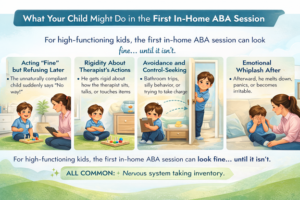
If your child is high-functioning, the first session can look deceptively fine… until it isn’t.
Some kids mask. Some perform. Some charm. Some comply in the moment and fall apart later. Some keep it together all day at school and explode at home like a shaken soda.
In the first session, you might see:
- Your child “acting like everything is fine” but refusing later
- Sudden rigidity about how the therapist sits, talks, or touches items
- A spike in control-seeking behaviors (because a new person = uncertainty)
- Avoidance (bathroom trips, leaving the room, silly behavior, arguing)
- Emotional whiplash after the session ends
None of this means ABA “isn’t working.” It means your child’s nervous system is taking inventory.
If your child melts down during session one, the therapist should reduce demands, stabilize, and help you understand what happened. Not blame your child. Not blame you. Not bulldoze through.
In-home ABA therapy should feel practical: goals that actually matter
This is where I got picky—and you should too.
Goals should be tied to real life in North Carolina life: mornings, school routines, homework, community outings, sibling dynamics, church, sports practice, grocery store runs, family gatherings. Not abstract “compliance.”
Good early goals often look like:
- Functional communication: asking for help, breaks, space, clarification
- Flexibility: tolerating “wait,” changing plans, small disruptions
- Emotional regulation: recognizing escalation and using coping supports
- Independence: hygiene steps, bedtime routines, organizing school items
- Safety: responding to name, staying near, door safety, street awareness
- Social navigation: back-and-forth conversation, boundaries, perspective-taking
If you hear goals that make your kid sound like a robot, pause. The best plans are built to reduce distress and increase autonomy—not to make your child “easier.”
How to prepare your home without turning it into a clinic
Please do not panic-clean. This is not HGTV. This is Tuesday.
Do these instead:
- Pick one main space (living room, kitchen table, play area)
- Have a few high-interest items available (favorite activity, snack if appropriate, game, sensory tools)
- Reduce competing noise if you can (TV down/off, fewer screens nearby)
- Tell the clinician any safety concerns immediately (doors, pets, stairs, elopement risk)
- Write down your top 3 priorities so you don’t blank in the moment
If your home is chaotic, that’s not something to hide. That’s something to design around.
Metaphor that stuck with me: In-home ABA therapy is like installing guardrails on a winding mountain road. You’re not “fixing the road.” You’re making it safer to drive.
What to watch for after session one (green flags and red flags)
Green flags
- The clinician talks to your child with respect, not baby-talk or power plays
- They explain what they’re doing in plain language
- They prioritize rapport before demands
- They ask about your child’s preferences and sensory needs
- They talk about progress as skills gained, not “behaviors eliminated”
- They invite you in without making you feel blamed
Red flags
- “We need to break them of this” language
- Pushing compliance immediately without relationship-building
- Ignoring distress cues (shutting down, panicking, escalating)
- Goals that sound like “make them normal”
- You feeling dismissed when you share what’s hard at home
You’re allowed to advocate. You’re allowed to ask for clarification. You’re allowed to switch providers if it doesn’t feel right.
Next step if you’re considering in-home ABA therapy in North Carolina Call (848) 220-1937
If you’re in North Carolina and you’re trying to figure out whether in-home ABA therapy fits your child and your household, you don’t have to do this alone. Call (848) 220-1937 or email: office@avantaba.com